Overview
The S&P 500 lost .95% in June. The Nasdaq 100 lost 2.75%, while the Russell 2000 (small cap index) gained 3.74%. The dispersion in returns between large capitalization indices and the Small Cap index had principally to do with the market reassessing the likelihood of the Federal Reserve (Fed) hiking rates rather than keeping them stable, over the remainder of the year. The rising probabilities of one or several Fed rate hikes due to inflation caused the sectors with the most elevated valuations to suffer and the undervalued ones to benefit.
Internationally, the market reaction to this development was more muted. The EPAC BM Index (International developed economies) shed 1.05% while the MSCI EM (emerging markets) lost 1.36% but the MSCI Frontier 100 index gained 1.96%.
The chart below illustrates the reasons behind the reassessment of the Fed’s likely posture going forward:
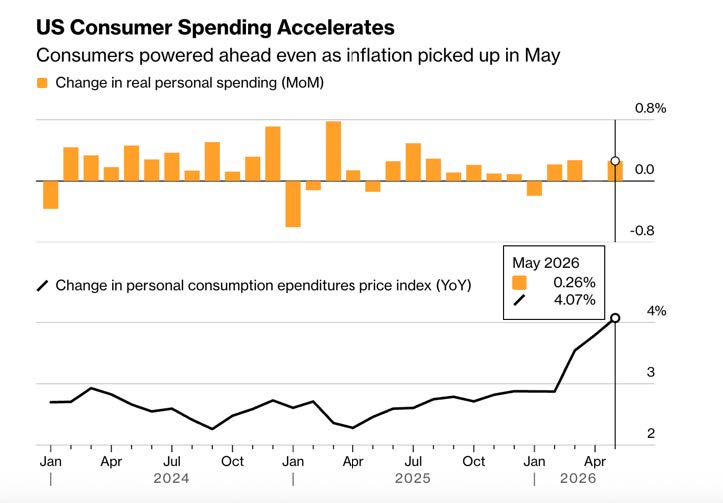
The US consumer keeps on consuming and inflation keeps on rising. In that context, the Fed’s double mandate to keep inflation in check and support employment is likely to lead it to prioritize reducing inflation in the near-term over being concerned about employment.
In June, US fixed income markets were slightly up. The US bond aggregate gained .24%. Investment grade corporate bonds rose .18%, while high yield corporates returned .27% and the long bond gained 1.52%.
Our median portfolio was up .43% in June. Over the same period, a portfolio consisting of 50% ACWI (All Country World Index) and 50% AGG (US Bond Aggregate) declined .06%. Overall, our median portfolio is up 5.58% YTD (Year-To-Date) vs. 6.20% for our benchmark.
Market developments
The most significant event of the month, from a market perspective, was the first meeting of the Fed under its new Chairman, Kevin Warsh. That gathering took place on Tuesday and Wednesday June 16 and 17. The hawkish tone that transpired from the short summary provided by Chair Warsh, following the meeting, surprised market observers. It caused investors to question their assumptions that the Fed might become less focused on fighting inflation under its new leadership. This caused the yield curve to flatten, with the long bond rallying and the priciest parts of the US equity markets to lose steam, as illustrated below:
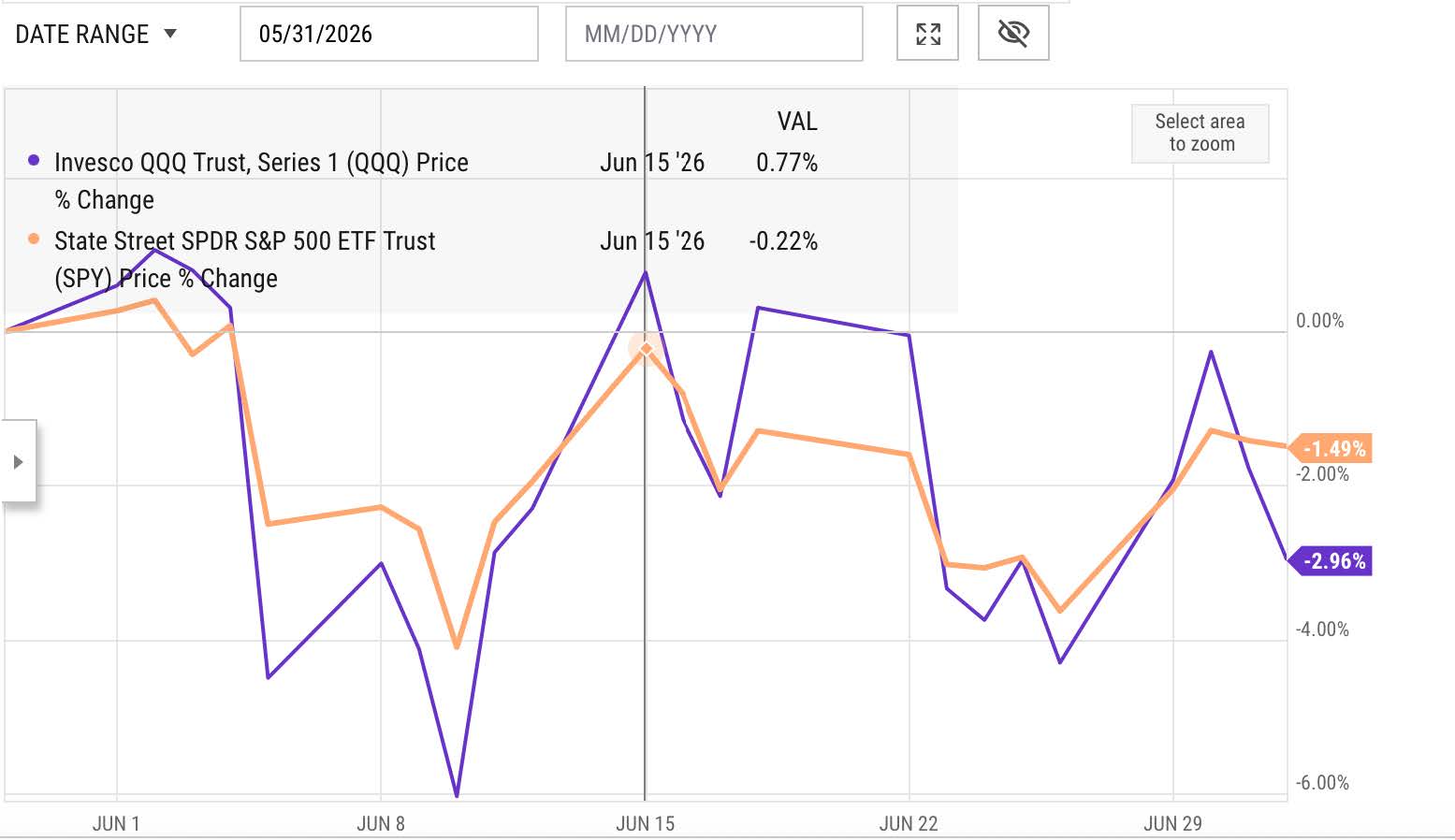
The vertical line marks the day of the beginning of the Fed’s meetings. Since then, the S&Ps’ 500 and the Nasdaq have respectively lost 2% and 3.5% (as of this writing). Since the US economy is performing rather well, other sectors of the equity markets have not been affected negatively. The Fed’s message appears to have caused market participants to become a bit more cautious about funneling so much money to the largest capitalization stocks and to the promoters and beneficiaries of the AI revolution (often one and the same).
Overall, inflation seems to be persistent. The US consumer seems upbeat enough, if not in spirit at least in deeds. The labor market remains sturdy. In that context, the Fed has room to push its intervention rate (Fed fund rate) up at the next gathering (end of July) or at the beginning of September without causing serious damage to the economy. Whether it will remains to be seen.
Portfolio Commentary
Our portfolios are starting to benefit from the more prudent stance taken by the average equity investor since the Fed’s meetings.
We are generally overweight value stocks and have seen that sector gain some momentum lately, as illustrated below:
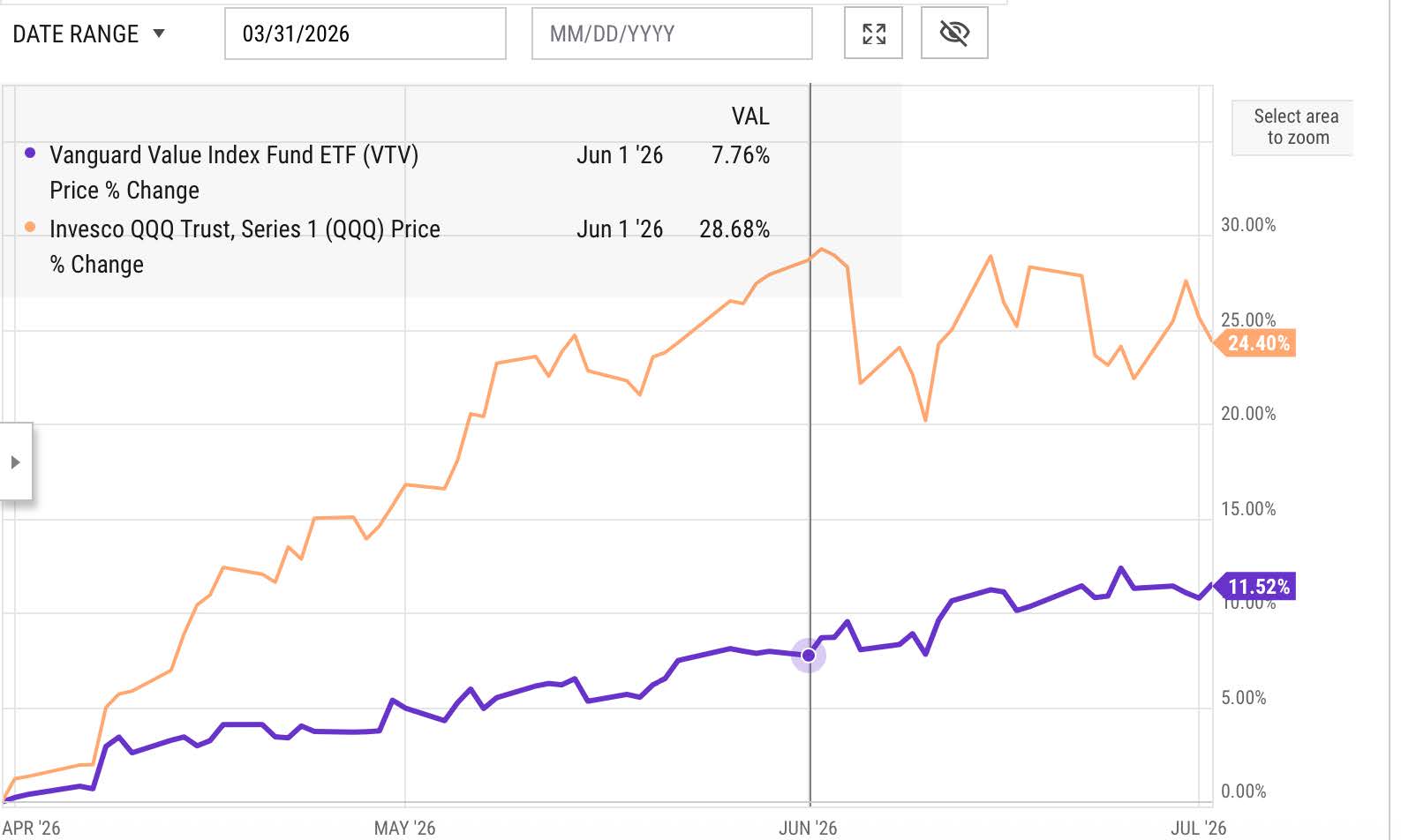
While the tech sector (Orange line above) has stagnated or dropped since mid-June, the value sector has progressed (blue line). That said, the gap in performance between these sectors since early April remains wide (about 13%). I am of the belief that the gap may be gradually filled if the economy remains solid and the Fed’s hawkish stance persists.
From a portfolio allocation standpoint, I remain slightly underweight US stocks. As for our fixed income investments, I have tilted our allocation in favor of medium-term securities (AGG has a duration of about five to six years) as our US treasuries were maturing.
Looking ahead, I expect more volatility in the tech and large cap sectors, particularly if the spectacular rate of growth of their earnings is not maintained, a very likely development.
Conclusion
We are entering a period of the year traditionally a bit more volatile than usual. This is due to market participants enjoying the good summer weather. With less liquidity, market swings tend to be amplified as a result. Do not be surprised if the month of July fits that pattern.
Overall, other than a continuing rotation out of the most expensive parts of the US equity market in favor of value stocks, I do not expect much to happen through the end of this month.
Perhaps the best thing to do for now is to enjoy the tremendous games at the World Cup! Allez les Bleus!
Thank you for your continued trust.
Jeff de Valdivia, CFA, CFP
Fleurus Investment Advisory, LLC
www.fleurus-ia.com
(203) 919-4980