
Overview
September was a tumultuous month for equities globally. While the US tech sector registered a positive performance, most others declined, together with equities around the world.
The S&P 500 lost .35% in September. The Nasdaq Composite rose 1.93%, while the Russell 2000 (small-cap index) dropped 5.25%.
Internationally, rising US bond yields help propel the USD forward causing most non-USD denominated assets to decline. The EPAC BM Index (International developed economies) lost 3.03% while the MSCI EM (emerging markets) shed a smaller .50%.
The equity losses were the result of a sharply rising interest rate environment in the US. Bond yields jumped up, the result of rising oil prices, ever-present worries about inflationary pressures and the length and speed of a new FED interest rate tightening cycle. The chart below illustrates the recent rise in bond yields.
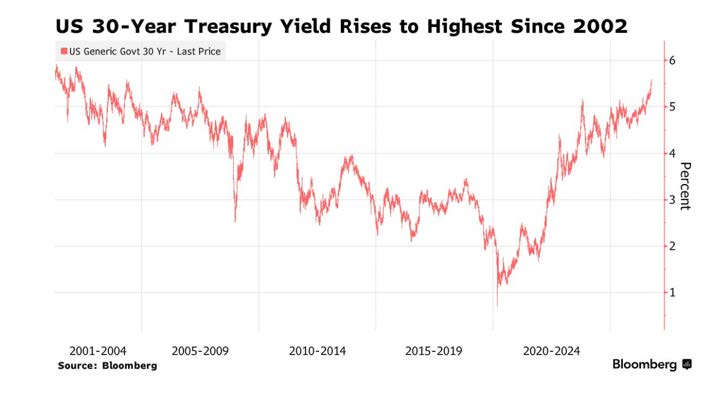
All things equal otherwise, a rising yield environment is to an equity market what a contrary wind is to a sailboat. While its effects vary depending on its causes, it generally portends a period of higher volatility and bouts of negative performances.
In September, US fixed income markets declined sharply. The US bond aggregate lost 2.61%. Investment grade corporate bonds dropped 2.72%, while high yield corporates shed 2.52% and the long bond cratered 4.98%.
Our median portfolio lost 2.00% in September. Over the same period, a portfolio consisting of 50% ACWI (All Country World Index) and 50% AGG (US Bond Aggregate) declined 1.90%. Overall, our median portfolio is up 4.71% YTD (Year-To-Date) vs. 5.08% for our benchmark.
Market developments
The decision by the FED to increase the fed funds rate by .25% on September 16, while largely anticipated, caused the bond market to accelerate its descent. Fears of persistent inflation, of a continuing conflict in the Middle East and uncertainty about the duration and intensity of the interest rate tightening cycle, put pressure on most risk assets and equity sectors.
Interestingly though, this development occurred while US consumer confidence remains relatively stable, as shown below, and with a relatively stable employment picture:
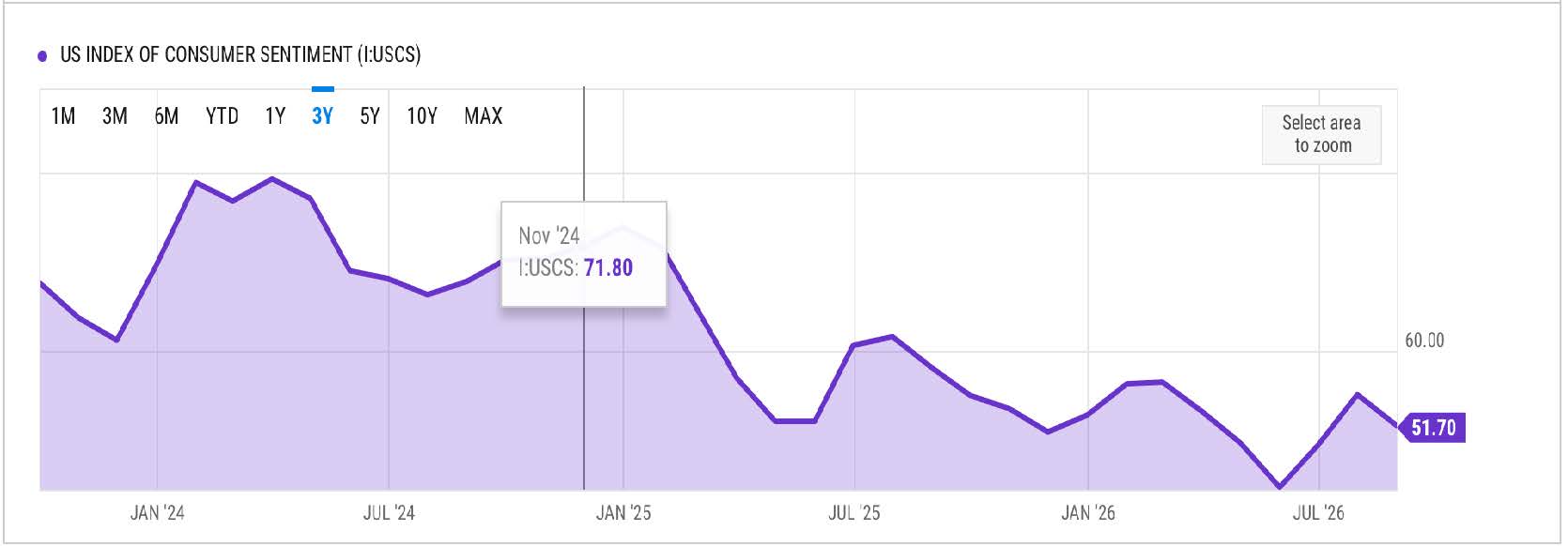
Consequently, after a day or two of uncertainty, investors decided that there were no real reasons to stop piling into the tech sector, at the expense of almost everything else, as shown below:
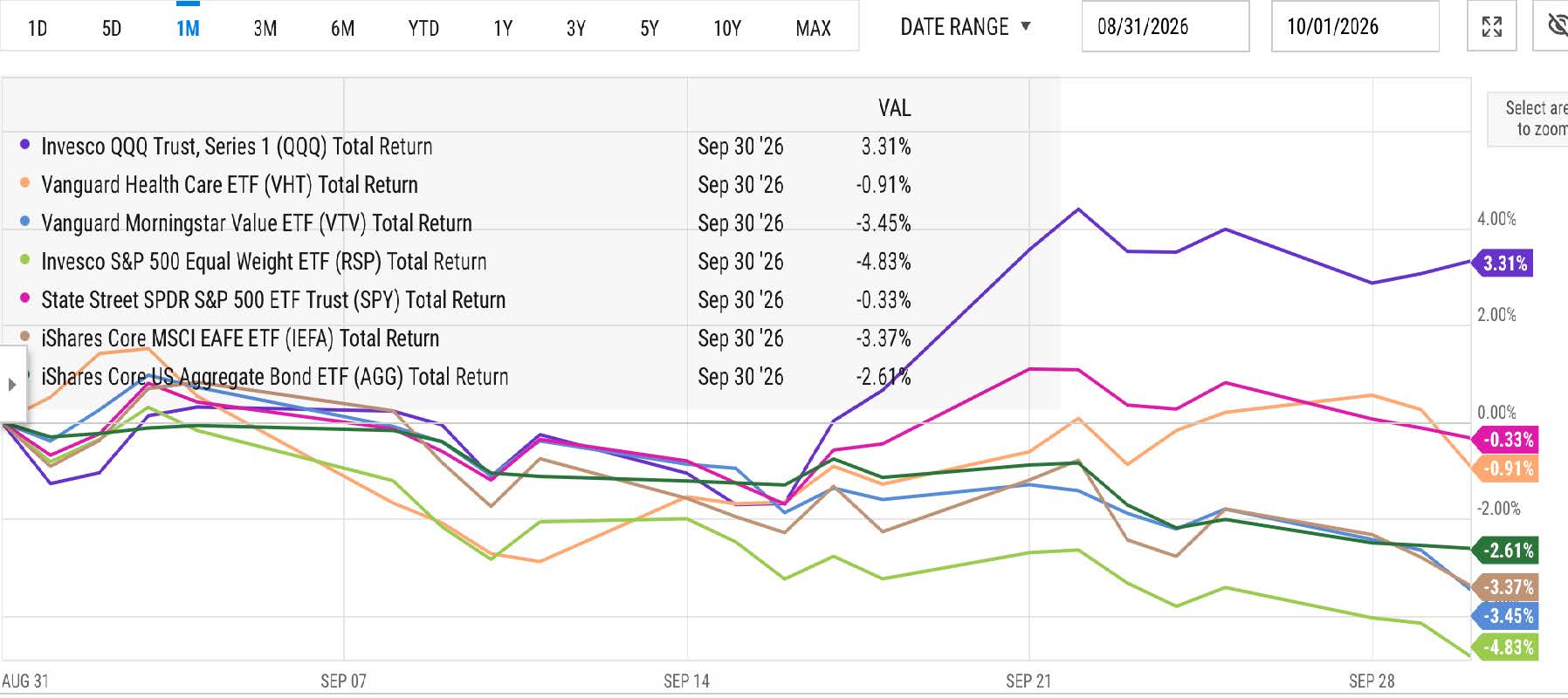
There is a lot on this graph. The crux of it though is simple: All equities (and the lines that represent them) were down in September except QQQ, the tech ETF. From bonds (AGG) to IEFA (international developed markets), to the health care sector (VHT) and the value sector (VTV), nothing escaped losses outside the tech sector. It is as if the AI (artificial intelligence) infrastructure buildup is swallowing the US economy.
The resulting momentum driven market will stop eventually. Anticipating the timing of the inevitable reversal though remains a complicated exercise.
Portfolio Commentary
The fast rise in bond yields has caused the USD to move rapidly up in September. The chart below shows the progression of the USD vs. a basket of currencies during the past month:
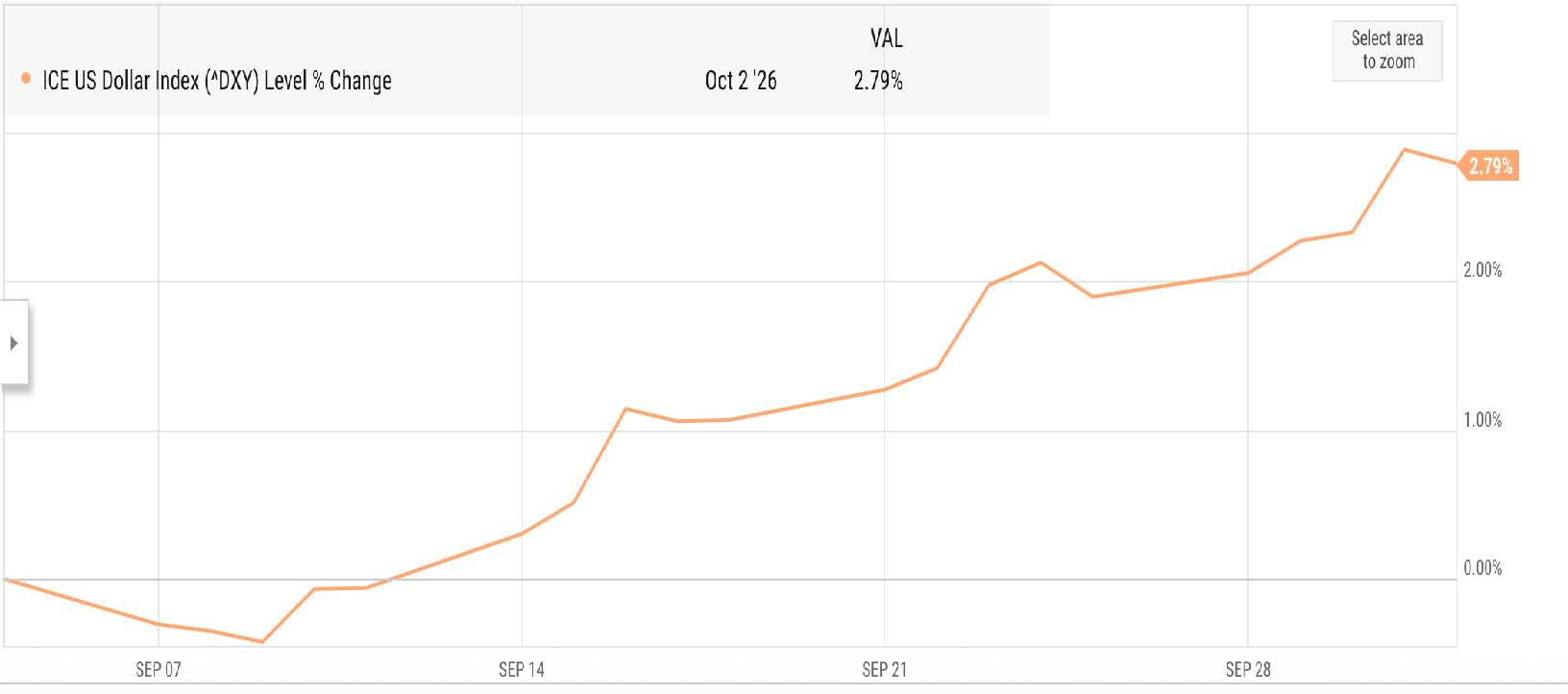
The USD index (DXY) moved up by 2.79%. The magnitude of such a move is rarely seen. It caused international stocks to swoon.
Our main exposure to this sector is via IEFA, the ETF tracking the performance of international developed markets. Since I do not anticipate a significant reversal in the USD against other major currencies until US interest rates stabilize, I decided to reduce our international exposure where I could.
Given the large capital gains embedded in those positions, I sold IEFA mostly in qualified accounts (IRAs etc…). I may continue doing so going forward.
The other striking development that the month of September highlighted, with particular intensity, is the concentration (lack of breadth) of this market.
One way to illustrate this phenomenon is to compare the performance of the S&Ps’500 index (a capitalization index) to that of its equally weighted brethren.
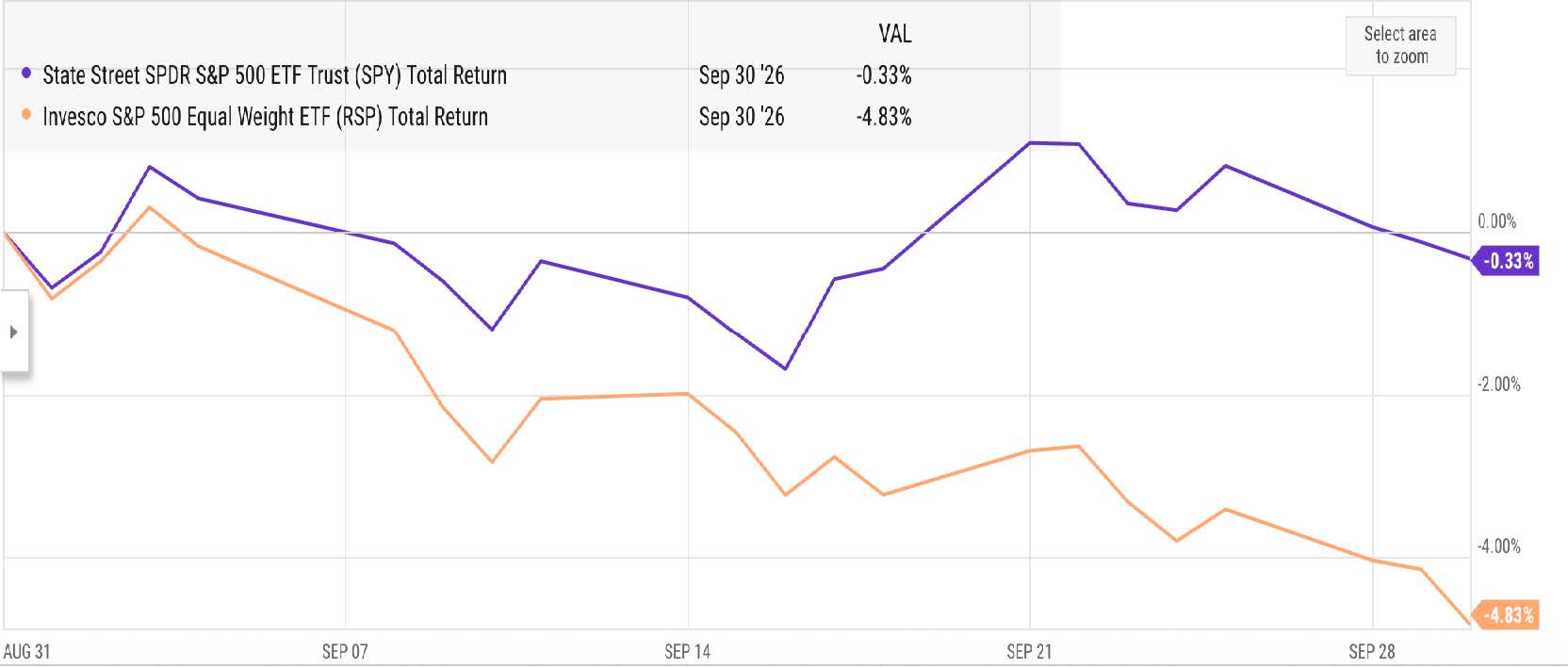
The S&P 500 (purple line) barely lost momentum in September. This is because 40% of its performance is attributable to ten (very large) stocks, mostly from the tech sector. On the other hand, if you owned the other 490 stocks, on an equal weighted basis, you would have lost more that 5%. This is staggering. It is not new. It has been developing over the past few years.
It is now reaching levels that increase the probability of a market correction over the coming months.
Conclusion
The US economy is doing relatively well from an employment and consumption point of view.
However, with inflation stubbornly high, a new interest rate tightening cycle started and a market increasingly dependent on the sustainability of the AI infrastructure boom, prudence is called for.
Thank you for your continued trust.
Jeff de Valdivia, CFA, CFP
Fleurus Investment Advisory, LLC
www.fleurus-ia.com
(203) 919-4980